Artificial Intelligence (AI) Courses Online: How to Choose the Right AI Course in 2026
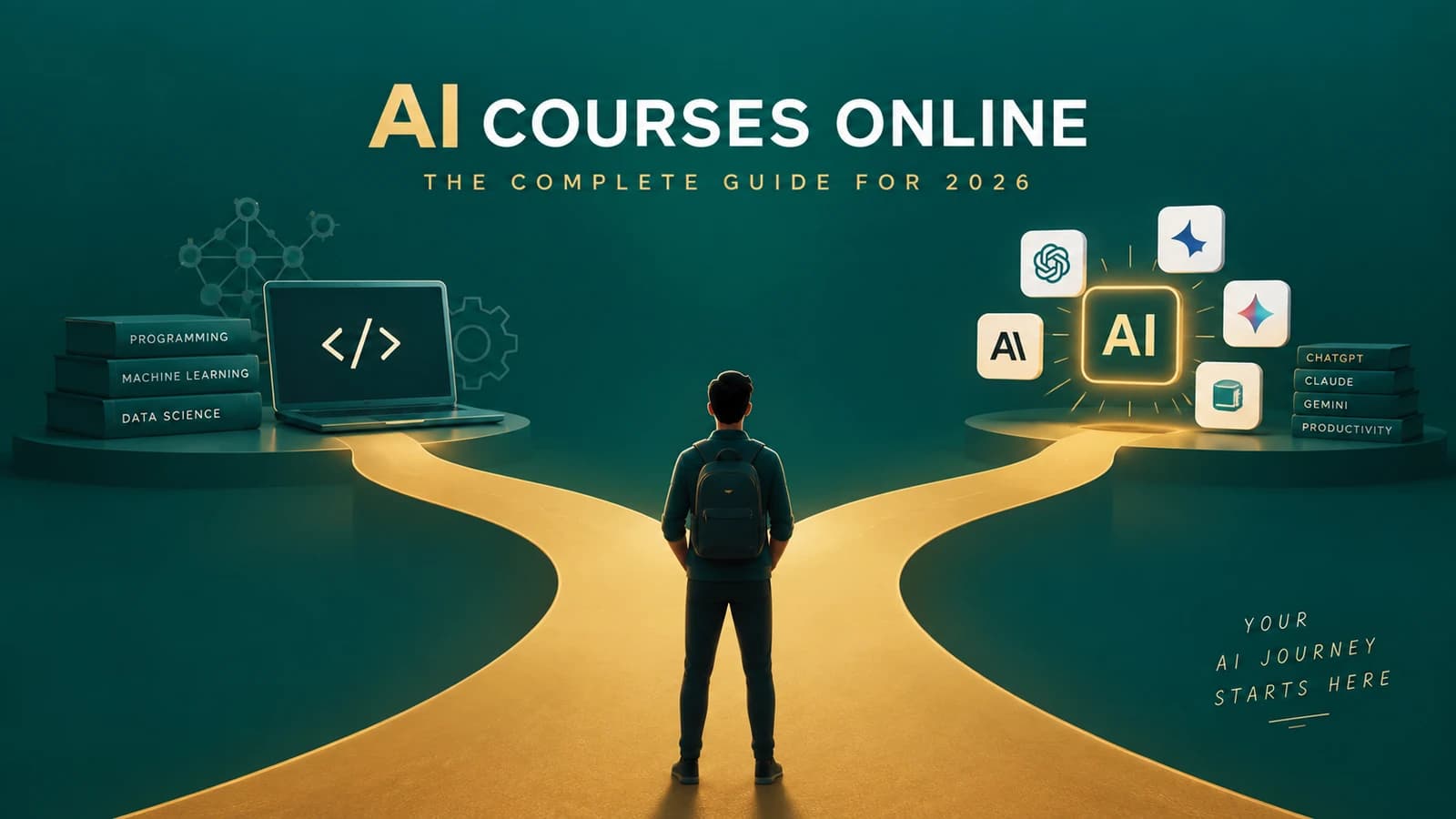
Quick answer: Online AI courses fall into a few different categories — from technical machine-learning programs to practical courses that teach you to use tools like ChatGPT and Claude. The right course depends on your goal: do you want to build AI, understand how it works, or simply use AI tools better?
Search for "artificial intelligence courses online" and you'll get a flood of results — university machine learning programs, coding bootcamps, generative AI courses, certification programs, and short practical workshops, all mixed together. If you're not sure what you actually need, it's easy to enrol in the wrong one.
This guide breaks down the main types of AI courses, who each one is for, and how to pick the right one — so you don't have to guess.
Types of AI Courses Online
Artificial intelligence courses online generally fall into six broad categories.
1. AI Fundamentals Courses
For beginners who want to understand the basics: what AI is, how machine learning works at a high level, what generative AI and large language models are, common AI applications, and the idea of using AI responsibly. No coding involved.
2. AI & Machine Learning Courses
For people who want to build AI systems, not just use them. These courses cover Python, statistics, machine learning, deep learning, natural language processing, computer vision, tools like TensorFlow and PyTorch, and how to develop your own models. Coding is required, and these courses usually take months.
3. Generative AI Courses
A fast-growing category focused on the AI tools that write, chat, and create. Covers tools like ChatGPT, Claude and Gemini, how large language models work, prompt engineering, and newer topics like retrieval-augmented generation (RAG) and AI agents.
4. Practical AI Tools Courses
These skip the technical side entirely and teach you to actually use AI tools that already exist — ChatGPT, Claude, Gemini, Microsoft Copilot, Perplexity, NotebookLM, Canva AI and others — for real work like research, writing, content creation and day-to-day productivity. This is where AivaanTech's own course fits.
5. AI for Business & Professionals
Built for managers, marketers, teachers, entrepreneurs, HR teams and business owners who want to bring AI into their existing work — not become AI developers.
6. AI Certification Courses
Certificates come in different forms: a simple certificate of completion, a professional certification, a university-backed certification, or a project-based certification you earn by actually building something. People searching for AI courses very often also search for certification, so it's worth understanding which type you're getting before you enrol.
Popular Online AI Course Platforms
| Platform | Best suited for | Typical focus |
|---|---|---|
| Coursera | Beginners to advanced learners | AI, machine learning, generative AI, certificates |
| Udemy | Affordable, self-paced learning | AI tools, programming, generative AI |
| edX | Academic and professional learning | AI, machine learning, computer science |
| University programs | Structured, longer professional learning | AI/ML, business AI |
| AivaanTech | Practical AI tool skills | Generative AI, prompting, AI productivity |
Course pricing, duration and availability change often — check each provider's current course page before enrolling.
Which AI Course Should You Choose?
The right course depends on who you are and what you're trying to get out of it.
AI courses for students — look for a beginner-friendly course that builds a resume-ready skill without requiring a technical background first.
AI courses for working professionals — focus on productivity, research, automation and workplace applications you can apply immediately.
AI courses for beginners — start with an AI fundamentals or practical AI tools course. No technical background needed.
AI courses for programmers — a machine learning or AI engineering course (Python, APIs, model development) will teach more relevant depth than a tools-focused course.
AI courses for business owners — look for courses covering automation, marketing, customer support and analytics.
AI courses for teachers — look for courses covering lesson planning, research, content creation and other education workflows.
AI Course Types Compared
| Course type | Coding required | Typical duration | Best for |
|---|---|---|---|
| AI fundamentals | No | A few weeks | Beginners |
| Generative AI | Usually no | A few weeks | Students and professionals |
| AI tools (practical) | No | Days to weeks | General users |
| Machine learning | Yes | Months | Aspiring ML professionals |
| Deep learning | Yes | Months | Technical learners |
| AI engineering | Yes | Months | Developers |
| AI for business | Usually no | Weeks to months | Managers and business users |
Can You Learn AI Without Coding?
Yes — you can learn to use many modern AI tools without ever writing a line of code. However, building AI models, developing machine-learning systems, or creating AI applications generally requires significantly more technical knowledge, including programming.
So "no coding required" is a real, meaningful distinction. If your goal is to get better, faster results out of tools like ChatGPT and Claude, that's a communication skill you can learn without touching code. If your goal is to build the next AI model, that's a different, longer, code-heavy path.
How to Choose an AI Course Online
Before enrolling in any AI course, check these ten things:
- Your goal — do you want to use AI, or build AI?
- Your current skill level — beginner, intermediate, or technical.
- The actual curriculum — look at the real modules, not just the course title.
- Hands-on work — does the course include real projects and exercises, not just videos?
- Tools covered — for generative AI courses, check the tools are current.
- Instructor credibility — check the instructor's real experience and background.
- The certificate — understand what it actually represents before you rely on it.
- Course format — self-paced, live, cohort-based, or hybrid.
- Duration — a 2-week practical course and an 11-month machine-learning program solve very different problems.
- Cost — compare what's included, not just the price.
AivaanTech's Approach to AI Learning
AivaanTech focuses on practical, no-code AI skills rather than machine-learning model development. Its AI Tool Mastery — 30-Day Certification (opens in a new tab) covers tools such as ChatGPT, Claude, Gemini and Microsoft Copilot, along with prompt engineering, practical use cases and a capstone project.
It's designed for learners who want to apply AI tools in study, work and everyday tasks — not train as AI engineers or machine-learning developers.
Explore AI Tool Mastery — 30-Day Certification → (opens in a new tab)
Frequently asked questions
What are the best AI courses online for beginners?
Can I learn AI online without coding?
What is the difference between an AI course and a machine learning course?
Are there free AI courses online?
Which AI courses provide certificates?
How long does an online AI course take?
How much do AI courses online cost?
Is an AI certificate worth it?
Should I learn generative AI tools first, or focus on machine learning?
What AI course should I take as a working professional?
Ready to go deeper?
Explore the full 30-day AI Tool Mastery certification — prompt engineering, 11+ tools and a real capstone project.