
Prompt Engineering Course Online: Learn to Get Better Results from AI
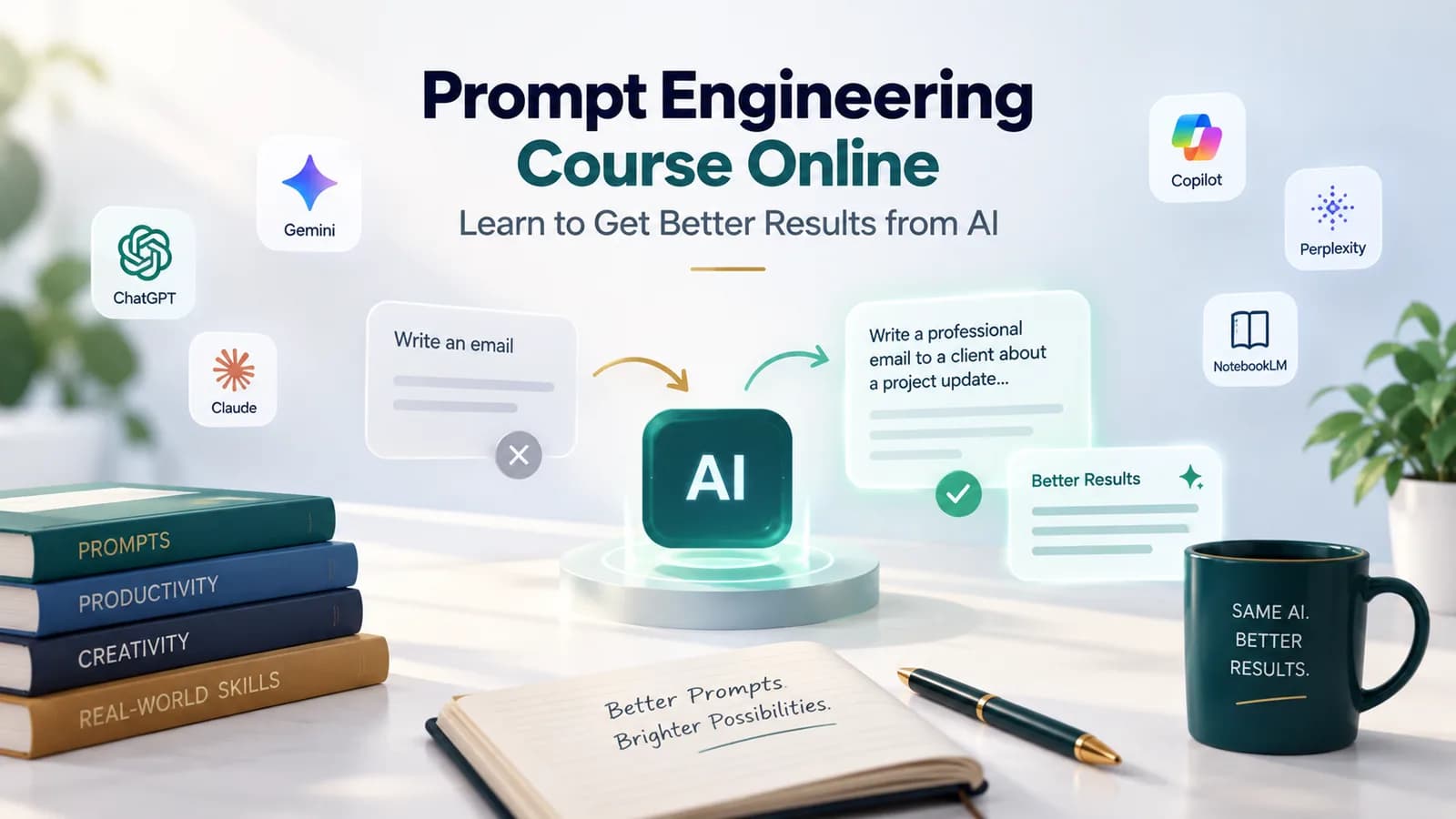
Quick answer: A prompt engineering course teaches you how to communicate clearly with AI tools so you get accurate, useful answers instead of vague or generic ones. It's a practical skill, not a technical one — anyone can learn it, no coding required.
If you're looking for a prompt engineering course online, you're probably trying to get better results from ChatGPT, Claude, Gemini, or other AI tools. A good course should teach more than a collection of ready-made prompts — it should show you how to structure instructions, provide context, refine AI responses, and apply prompting techniques to real-world tasks. Here's what that actually looks like, what a proper curriculum covers, and how to tell a course that delivers from one that doesn't.
What Will You Learn in a Prompt Engineering Course?
A structured course moves through five areas, each building on the last — not a random list of tips.
Module 1: AI & Prompt Engineering Fundamentals
- What generative AI is
- How AI assistants interpret prompts
- Types of prompts
- Common prompting mistakes
Module 2: Prompt Engineering Techniques
- Zero-shot prompting
- Few-shot prompting
- Role prompting
- Context prompting
- Step-by-step instructions
- Prompt refinement
Module 3: Prompting with AI Tools
- ChatGPT
- Claude
- Gemini
- Microsoft Copilot
- Perplexity
- NotebookLM
Module 4: Real-World Prompting
- Content creation
- Research
- Marketing
- Productivity
- Data analysis
- Business tasks
Module 5: Capstone Project
- Build a practical AI workflow
- Apply prompting techniques
- Solve a real-world problem
Weak vs Better Prompt: Real Examples
The gap between a mediocre AI answer and a genuinely useful one usually comes down to four things: context, structure, format, and constraints. Here's what that looks like in practice.
1. Social media post
Weak prompt:
Write a LinkedIn post about AI.
Better prompt:
Write a 150-word LinkedIn post about how students can use AI tools for research and productivity. The audience is Indian college students. Use a professional but conversational tone. Start with a strong hook and finish with a question that encourages comments.
Why this works better: the weak version leaves every decision — audience, length, tone, structure — up to the AI to guess. The better version answers those questions upfront, so there's nothing left to guess.
2. Work email
Weak prompt:
Write a follow-up email.
Better prompt:
Write a follow-up email to a client who hasn't responded in two weeks about a project proposal. Keep it under 100 words, polite but direct, and end with a specific ask for a call this week.
Why this works better: "follow-up email" could mean dozens of different situations. Naming the relationship, the timeline, and the exact outcome you want turns a generic draft into something you could send as-is.
3. Research and study
Weak prompt:
Summarize this article.
Better prompt:
Summarize this article in 5 bullet points for someone preparing for a college exam. Highlight any statistics or dates that are likely exam-relevant, and flag anything that contradicts commonly taught theory.
Why this works better: a plain summary treats every sentence as equally important. Telling the AI who the summary is for and what to prioritize gets you a version you can actually study from.
4. Business and data analysis
Weak prompt:
Analyze this sales data.
Better prompt:
You are a business analyst. Analyze this sales data and identify the three biggest month-over-month changes. For each one, suggest one possible cause and one follow-up question I should ask the sales team. Keep the answer under 200 words.
Why this works better: "analyze" on its own could produce a wall of observations with no clear use. Asking for a fixed number of findings, a specific angle (cause), and a next step (a question to ask) turns raw output into something you can act on in a meeting.
Who Should Take a Prompt Engineering Course Online?
This isn't a niche skill anymore. People across very different roles are searching for a prompt engineering course for the same basic reason — they want AI tools to actually help them, instead of producing something they have to rewrite anyway.
- Students using AI to research, study, or prep for interviews
- Working professionals who use AI daily for writing, analysis, or planning
- Managers and executives trying to use AI for decisions, not just drafts
- Teachers building lesson content or classroom materials
- Marketers and content creators who need consistent, on-brand output
- Anyone with no coding background who wants to get more out of tools they already use
Prompt Engineering Course vs Free Tutorials
Free YouTube tutorials are a reasonable starting point, but they solve a different problem than a structured course does.
| Free Tutorials | Structured Course | |
|---|---|---|
| Learning approach | Individual techniques, watched in isolation | A guided path that builds one skill on the next |
| Tool coverage | Often tool-specific | Transferable principles across tools |
| Practice | Limited, one-off examples | Repeated, hands-on exercises |
| Assessment | None | Projects and a capstone |
| What to learn next | Unclear — up to you to figure out | A structured curriculum |
This isn't a case against free tutorials — they're a fine way to see what prompting even looks like. But if you want the skill to actually stick, a structured course gives you the repetition and feedback that a one-off video can't.
What Makes a Good Prompt Engineering Course?
Rather than taking any one course's word for it, check for these before you enroll:
- Beginner-friendly curriculum
- Multiple AI tools
- Hands-on exercises
- Real-world use cases
- Capstone project
- Certification
- Updated curriculum
- Instructor credibility
- Self-paced or live learning options
- Practical outcomes
AivaanTech's AI Tool Mastery — 30-Day Certification is built around this exact checklist, and prompt engineering is one of its core modules.
AivaanTech AI Tool Mastery: What You'll Learn
- Duration30 days
- FormatSelf-paced
- LevelBeginner-friendly
- CodingNo coding required
- AI toolsChatGPT, Claude, Gemini, Microsoft Copilot, Perplexity, NotebookLM, and others
- Practical learningHands-on activities in every module
- Final projectA real capstone project
- CertificateCertification on completion
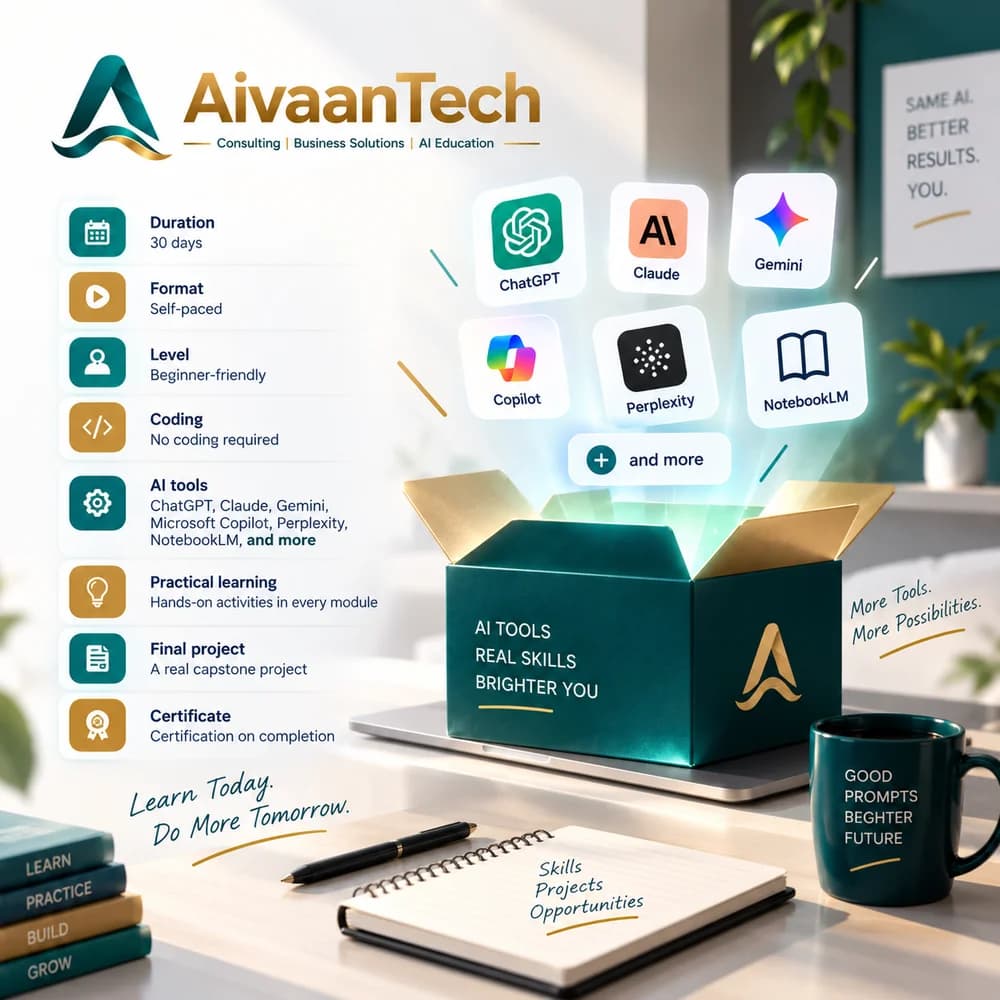
Prompting is taught through repeated, hands-on practice — not a one-off lesson — alongside the rest of the skills you need to actually use AI well at work or in daily life. Explore the full curriculum (opens in a new tab) as part of the broader AI Mastery Education track.
This is a good fit whether you're a student building a resume-ready skill or a working professional fitting learning around a job.
Frequently asked questions
What is the best prompt engineering course online?
How much does a prompt engineering course cost?
Is prompt engineering difficult to learn?
How long does a prompt engineering course take?
Is prompt engineering a good career in 2026?
Can I learn prompt engineering without coding?
What AI tools are covered in prompt engineering courses?
Do prompt engineering courses provide certificates?
Is a prompt engineering course worth it if I already use ChatGPT every day?
What's the difference between a prompt engineering course and free prompt templates online?
Ready to go deeper?
Explore the full 30-day AI Tool Mastery certification — prompt engineering, 11+ tools and a real capstone project.