
Gemini Training: Gemini and NotebookLM for Beginners
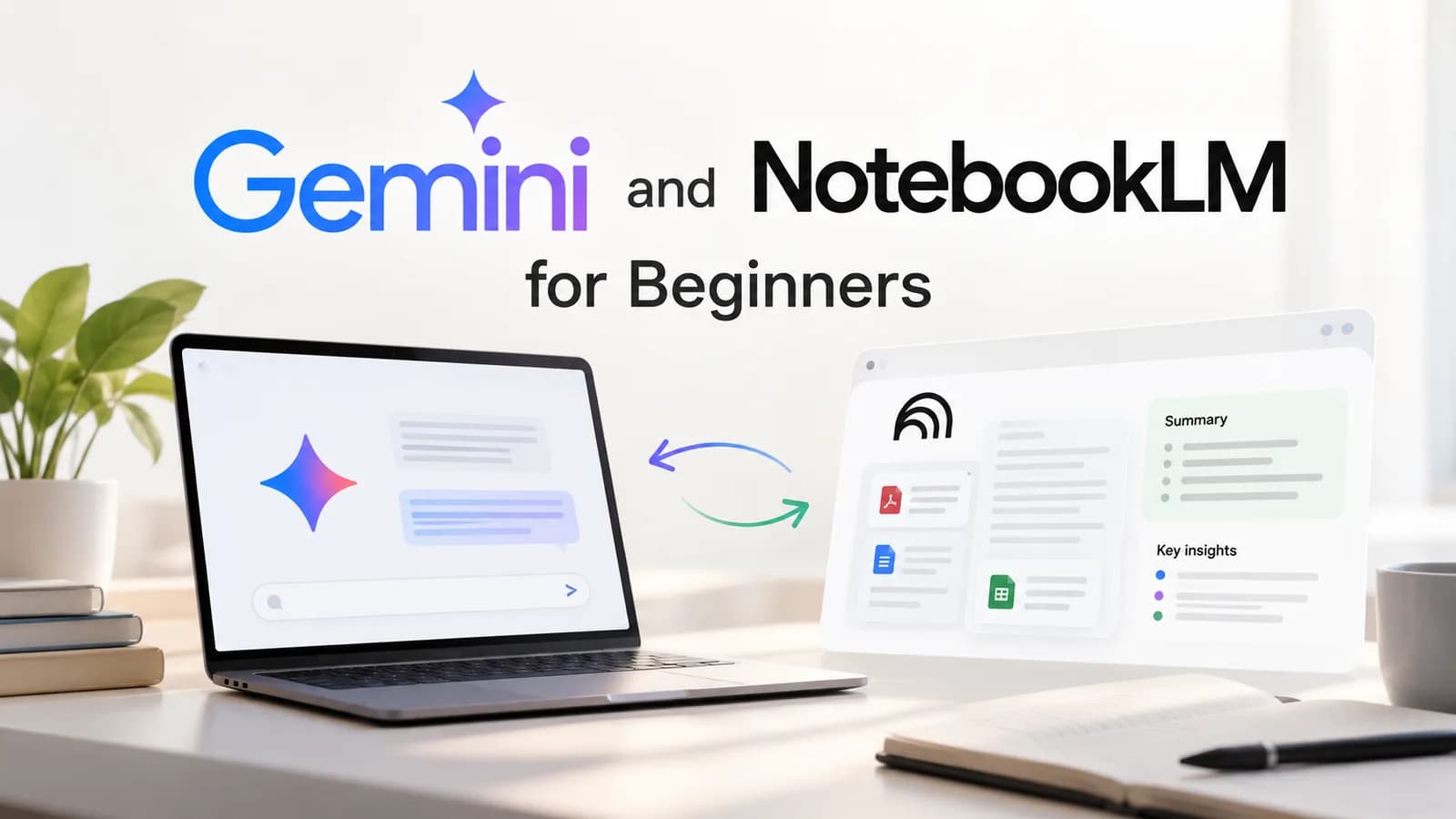
Quick answer: Gemini is Google's AI assistant for writing, research, images and work inside Google apps. NotebookLM (now called Gemini Notebook) is a separate tool that answers questions only from the documents you give it. For Gemini training, learn Gemini first for everyday tasks, then use NotebookLM when you need to study or research from your own files.
If you are new to AI, Google's tools can feel confusing. There is the Gemini app, Gemini inside Gmail and Docs, and a tool with a changing name that turns your PDFs into a podcast. Which one should you open, and for what?
This beginner guide gives you a simple Gemini training plan in plain English. You will learn what each tool does, how to write a good first prompt, how to build your first notebook step by step, and which workflows save the most time.
Gemini vs NotebookLM: what is the difference?
| Feature | Gemini | NotebookLM (Gemini Notebook) |
|---|---|---|
| What it is | A general AI assistant | A research and study assistant |
| Answers come from | Its own knowledge and the web | Only the sources you add |
| Best for | Writing, ideas, images, quick questions, Google apps | Studying, research and summarising your own documents |
| Citations | Sometimes | Yes, shown next to the answer |
| Learn it first if you... | want an everyday assistant | have reports, PDFs or notes to understand |
Think of Gemini as a smart helper who knows a little about everything. Think of NotebookLM as a helper who has read only the pages you handed over, and quotes them back to you.
A note on the name: Google has renamed NotebookLM to Gemini Notebook. It is the same tool. Many articles, videos and searches still use the old name, so you will see both. This guide uses "NotebookLM" with the new name in brackets where it helps.
Step 1: Learn the Gemini basics
Before you try anything advanced, spend your first session on these basics:
- Open Gemini in your browser or on your phone with your Google account, and ask a small question such as "Explain a pivot table in simple words."
- Know what it is good at: drafting, rewriting, summarising, brainstorming, explaining and planning.
- Know its limits: like every AI tool, it can be confidently wrong. Check important facts, numbers and dates.
- Protect your data: do not paste passwords, ID numbers or confidential company files into any tool your company has not approved.
Goal for Step 1: you can open Gemini, ask a question and decide whether the answer is trustworthy.
Step 2: Learn to write a good prompt
A prompt is the instruction you give Gemini. A clear prompt gets a far better answer. Use four parts:
- Goal: what do you want?
- Context: who is it for, and what background should Gemini know?
- Format: an email, a table, five bullet points, a short summary?
- Tone: simple English, formal, friendly, short?
Here is the difference it makes:
| Weak prompt | Strong prompt |
|---|---|
| "Write about our new product." | "Write a 100-word announcement of our new budgeting app for first-time users. Friendly tone, simple English, end with a question." |
| "Summarise this." | "Summarise this report in five bullet points for a busy manager. Include risks and next steps." |
Copy this prompt and fill in the brackets:
Act as a helpful assistant for a [your job] in India. Goal: [what you need done]. Context: [who it is for and any background]. Format: [email / table / bullet points / short summary]. Tone: simple English, professional, no jargon. If you need more information from me, ask before you write.
Always follow up. Your first answer is a draft, so say "make it shorter," "add an example" or "make the tone warmer." For more patterns, read 5 ChatGPT prompt templates that actually work. They work in Gemini too.
Step 3: Learn the useful Gemini features
Once you are comfortable with basic prompts, these features save the most time.
Gems: your own saved assistants
A Gem is a custom version of Gemini with instructions you save once, such as "You are my email editor. Keep replies under 120 words and polite." You can reuse it every time instead of explaining your needs again.
Canvas: write and edit side by side
Canvas opens a workspace next to the chat, where you and Gemini can draft and edit a document together. You can ask for changes to a selected paragraph, then export the result to Google Docs.
Deep Research: a full report from many sources
Deep Research is for bigger questions. Gemini searches many sources and writes a longer report with links. It takes a few minutes, so use it for topics such as comparing tools or learning an unfamiliar market. Always open the sources and check them.
Gemini Live: talk instead of type
Gemini Live lets you have a spoken conversation with Gemini on your phone. It is useful for practising an interview, talking through an idea, or asking questions while your hands are busy.
Gemini in Google apps
If you use Gmail, Docs, Drive or Meet, Gemini can help inside them: summarising a long email thread, drafting a reply, or finding information in a document. What you can use depends on your plan and your organisation's settings. For a comparison with another popular assistant, see Gemini vs ChatGPT: which AI should you use?
Step 4: Learn NotebookLM (Gemini Notebook)
NotebookLM is the tool that makes many beginners say "I wish I had this in college." You add your own sources, then ask questions, and every answer is based on those sources, with citations you can click to check.
What you can add as sources
According to Google, a notebook can use:
- PDFs and text or Markdown files
- Google Docs and Google Slides
- Website links and pasted text
- Public YouTube videos
- Audio files
Each source can hold up to 500,000 words, or up to 200 MB for a file you upload. Other limits, such as the number of notebooks and daily use, depend on your plan and can change, so check Google's help page.
What it can create from your sources
- Chat answers with citations
- Summaries, study guides and briefings
- Audio Overviews: a short, spoken, podcast-style summary of your material
- Mind maps that show how ideas connect
- Other formats such as flashcards, quizzes and slide decks
Your first notebook, step by step
- Open NotebookLM (Gemini Notebook) with your Google account.
- Create a new notebook and give it a clear name, such as "Marketing report Q3".
- Add two or three sources you know well: a PDF, a Google Doc or a web link.
- Ask a simple question first, such as "What are the five main points of these sources?"
- Click the citations to confirm the answer matches the original text.
- Ask for something useful, such as "Create a study guide with ten questions and answers," or generate an Audio Overview to listen to while you travel.
- Ask for gaps: "What does this material not explain?" This shows you where to read more.
Goal for Step 4: you can build one notebook from your own documents and trust the answers because you checked the citations.
Step 5: Real workflows to try this week
Single features are useful, but workflows chain a few steps together. Here are four to start with.
Workflow 1: Study for an exam or a certification
- Add your notes, slides and a textbook chapter to one notebook.
- Ask for a study guide with the key terms.
- Generate practice questions, answer them yourself, then ask NotebookLM to check your answers and explain your mistakes.
Workflow 2: Understand a long report quickly
- Upload the report to NotebookLM.
- Ask for the five most important findings and the risks.
- In Gemini, turn those points into a short email for your manager. Check every number against the original.
Workflow 3: Research a topic from scratch
- In Gemini, use Deep Research to get a first overview with sources.
- Add the best sources to a notebook.
- Ask follow-up questions inside the notebook, so every answer stays tied to your chosen sources.
Workflow 4: Handle your inbox and meetings
- In Gmail, ask Gemini to summarise a long thread.
- Draft a reply, then edit it in your own voice.
- Save your preferred tone in a Gem so future replies need less editing.
If spreadsheets are part of your day, our guide on how to use ChatGPT for Excel shows the same prompting approach for formulas and data cleaning.
Common mistakes beginners make
- Using Gemini when NotebookLM is better. If the answer must come from your own documents, use NotebookLM so you get citations.
- Trusting every answer. Check facts, numbers and dates, especially before sharing work.
- Adding too many messy sources. A notebook with a few clear sources gives better answers than one with dozens of unrelated files.
- Weak prompts. "Summarise this" gives a weak result. Add who it is for and what format you want.
- Sharing private data. Follow your company's AI policy before uploading work files.
- Never following up. The second or third prompt is usually much better than the first.
A simple 2-week Gemini learning plan
| Week | Focus | Practice task |
|---|---|---|
| Week 1 | Gemini basics and prompting | Ask 20 real questions, rewrite five weak prompts, and save one Gem |
| Week 2 | NotebookLM and workflows | Build two notebooks from your own documents and try one full workflow |
Which tool should you learn next?
Gemini and NotebookLM are a strong pair, especially if you live in Google apps. But the best professionals know which tool fits which task: Gemini for Google work, a research tool for cited answers, and other assistants for writing and analysis. For the full picture, read AI tools for productivity: 11 worth learning in 2026.
The good news is that the core skill is the same everywhere: asking clearly and checking the answer. Learn it once and every new tool gets easier.
Get structured Gemini training with a certificate
Learning alone is possible, but a structured path saves time. AivaanTech's AI Tool Mastery certification teaches Gemini and NotebookLM alongside ChatGPT, Claude, Microsoft Copilot, Perplexity and other leading tools, with hands-on practice and prompting skills that work in all of them.
It is a 30-day program that needs no coding or prior AI knowledge, and it ends with a certificate you can add to your CV and LinkedIn. To train a whole team, see AI training for employees or contact us.
Frequently asked questions
What is Gemini training?
Is NotebookLM the same as Gemini Notebook?
What is the difference between Gemini and NotebookLM?
Is Gemini free to use?
Do I need coding skills to learn Gemini?
How long does it take to learn Gemini and NotebookLM?
Ready to go deeper?
Explore the full 30-day AI Tool Mastery certification — prompt engineering, 11+ tools and a real capstone project.