AI Transformation Consultant: What They Do & When to Use One
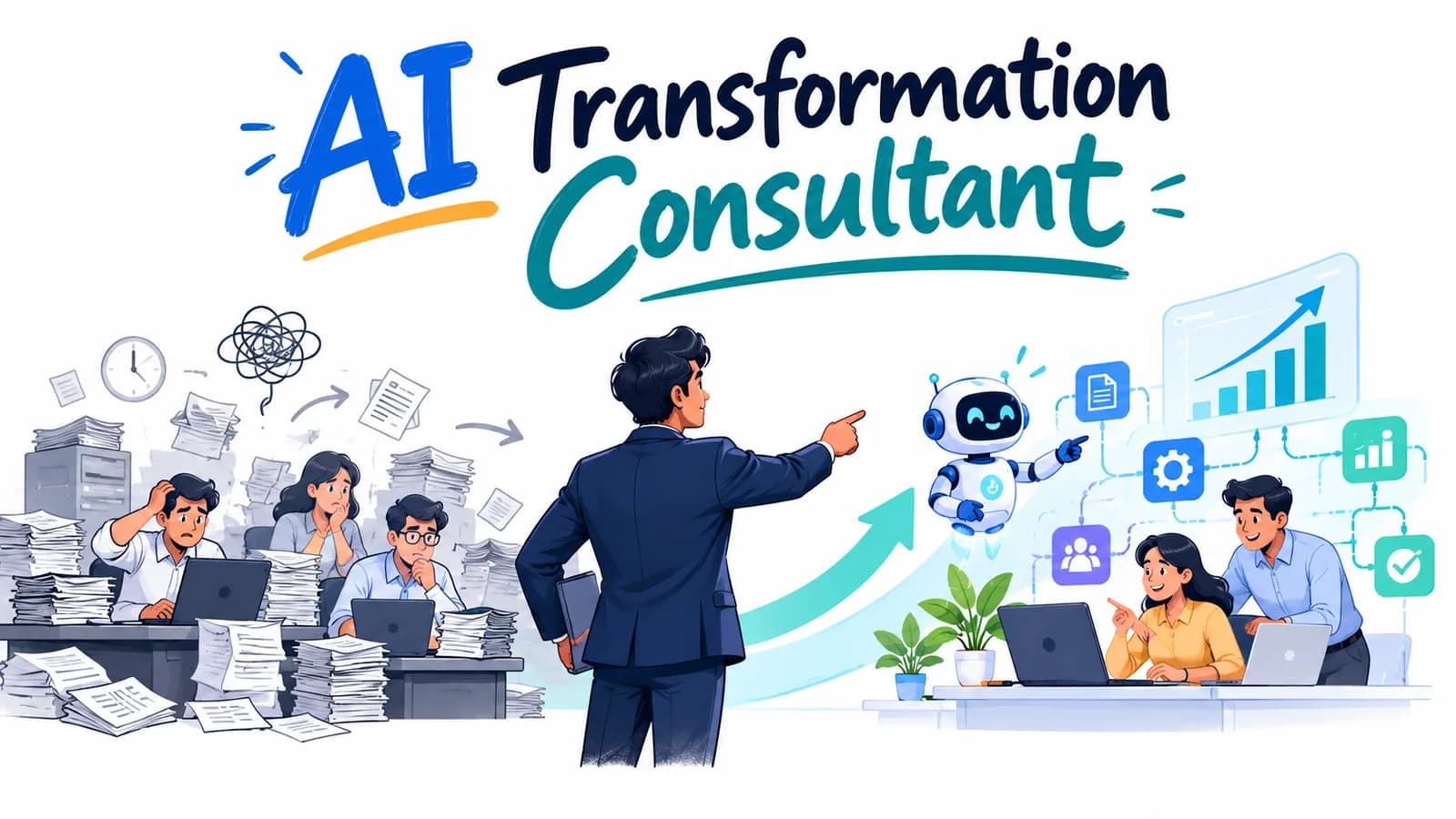
Quick answer: An AI transformation consultant helps a business move from scattered AI experiments to AI that is part of everyday work. They assess where you are, agree an AI transformation strategy with your leaders, build an AI implementation roadmap, prove the idea with a small pilot, and guide the rollout across teams. Bring one in when you know AI matters but cannot agree where to start, when pilots have stalled, or before a big technology decision.
Most companies today have tried AI in some way. A few people use ChatGPT, one team tested a chatbot, and someone bought a tool that nobody uses. The result is a lot of activity and very little change in how the business performs.
This guide explains in plain English what an AI transformation consultant does, what a good strategy and roadmap contain, how to choose the first use cases, and how to tell whether you need outside help. If you want to see how we work, our AI consulting services page covers the process in detail.
What is AI transformation?
AI transformation means using AI to change how your business actually works, not just trying a tool. It is the move from "some of us use AI" to "AI is built into our processes, our decisions and our team's skills."
That is different from adopting a single tool. Buying a writing assistant for the marketing team is adoption. Redesigning how leads are qualified, how reports are produced and how decisions are checked, with AI in the loop and a person responsible for each step, is transformation.
It is usually a series of small, measurable steps, not one big project. The companies that get results tend to pick a few good use cases, prove them, and then repeat what works.
What does an AI transformation consultant do?
A good AI transformation consultant does five jobs. They follow a simple order: assess, plan, build a roadmap, pilot, then scale.
- Assess where you are. They look at your current processes, tools, data and skills, and find where AI can realistically help and where it cannot yet.
- Set the strategy with leadership. They help your leaders agree which business goals AI should serve, so the work is tied to outcomes and not to a list of tools.
- Prioritise the use cases. They compare opportunities and choose the few that offer the best mix of value and feasibility.
- Build the roadmap and run a pilot. They turn the priorities into a sequenced plan, then test the strongest idea in a small, contained pilot with clear success measures.
- Guide the rollout. They help move the pilot's results across the business, including the changes in roles, governance and training that make the gains last.
The last step matters most. A roadmap that sits in a document changes nothing. The value comes from staying involved through the pilot and the rollout, then handing the plan to your own team to run.
AI transformation consultant vs other options
People often mix these up. This table shows who does what:
| Option | Main focus | Best when |
|---|---|---|
| AI transformation consultant | Strategy, roadmap, pilot and adoption across the business | You need direction and a plan before committing budget |
| General AI consultant | Advice on a specific AI question or use case | You have one clear problem to solve |
| IT consultant | Systems, infrastructure and software | The main challenge is technology setup, not outcomes |
| In-house AI team | Running AI day to day and knowing your business | You already have a direction and need people to run it |
| Training provider | Building your team's AI skills | Skills are the main gap, not strategy |
Many businesses use a consultant to set the roadmap and validate a pilot, then hand it to their own team. For a longer look at that choice, see the questions on our AI consulting page.
What a good AI transformation strategy includes
An AI transformation strategy is the written plan that links AI to your goals. Whatever the size of your business, it should answer these questions:
- Why: which business goals should AI help with, such as faster service, lower costs or better decisions?
- Where: which processes and teams will change first?
- What: which use cases are worth doing, and which should wait?
- Who: who owns each initiative, and who signs it off?
- How we measure it: what numbers will show it is working?
- What changes for people: which roles, skills and rules need to change?
- How we stay safe: what data can be used, and who reviews AI output?
If a plan cannot answer these in simple language, it is not ready. A strategy that starts with a tool name, and not a business goal, is a warning sign.
AI strategic planning: how to choose your first use cases
AI strategic planning is the work of deciding which opportunities to pursue and in what order. You do not need a complicated model. Score each idea from 1 to 5 on these five questions:
| Question | What it checks |
|---|---|
| Value: how much time, money or quality could this gain? | Whether it is worth doing |
| Feasibility: can today's AI do this reliably? | Whether it will actually work |
| Data: do we have the information it needs, in usable form? | Whether it can start soon |
| Risk: what happens if the AI is wrong? | Whether it needs strong checks |
| People: will the team use it, and who owns it? | Whether it will stick |
Start with ideas that score high on value and feasibility and low on risk. For example, summarising long documents or drafting routine replies is often a safer first pilot than letting AI make decisions about customers. Then stop and measure before expanding.
What an AI implementation roadmap looks like
An AI implementation roadmap puts the chosen use cases in order, with owners and dates. Here is an illustrative example of the shape of one. Real timelines depend on your size, data and goals, and should be agreed with your consultant before starting.
| Phase | What happens | What you have at the end |
|---|---|---|
| 1. Assess | Review processes, data, tools and skills; interview leaders and teams | A clear picture of where AI can help |
| 2. Plan | Agree the strategy, score and rank use cases | A prioritised list and success measures |
| 3. Pilot | Run one contained pilot on the strongest use case | Evidence from your own business |
| 4. Scale | Roll out to more teams, update roles, rules and training | Repeatable results and an owner for each initiative |
| 5. Review | Check the numbers, learn, and pick the next use case | A living plan, not a one-time document |
Notice that the pilot comes before the big investment. That order protects you from spending heavily on something that does not work in your business.
Signs you may need an AI transformation consultant
Outside help makes sense when:
- You know AI matters but leaders cannot agree where to start.
- Several pilots have run, but none have scaled.
- A large technology or vendor decision is coming up.
- You are spending on AI tools without measurable results.
- Different teams are buying different tools with no shared rules.
- You are worried about data, privacy or compliance and have no policy.
Signs you may not need one yet
- You only need a few AI tools for writing, research or customer replies. Training your team may be enough; see our guide to AI training for employees.
- You have no AI policy. Start there with our free AI usage policy template.
- You run a small business with one clear problem. Read AI tools for small business first.
- You already have a clear plan and only need people to carry it out.
Questions to ask before you choose a consultant
- What will we have at the end? Ask for specific deliverables, not general advice.
- How do you measure success? Look for numbers tied to your goals.
- Do you help after the plan? Good consultants stay through the pilot and rollout.
- Will my team own it afterwards? The goal is to hand it over, not to create dependence.
- How do you handle data and privacy? You should hear a clear, simple answer.
- Are you tied to specific tools? Tool choices should follow the strategy.
- How do you scope and price the work? Agree the scope and timeline in writing before you start.
- Can you work alongside our team? The plan should reflect how your company really runs.
Red flags
- A plan that starts with a tool, not a business problem.
- Big promises with no measures.
- No pilot, only a large rollout.
- A consultant who will not explain things in simple English.
- No plan for training, roles or governance.
Common mistakes in AI transformation
- Starting too big. Trying to change everything at once leads to stalled projects.
- Ignoring people. Tools fail when the team is not trained or does not trust them.
- No owner. Every initiative needs one named person responsible.
- No rules. Without a policy, staff may paste private data into public tools.
- No measures. If you cannot say what success looks like, you cannot tell whether it worked.
- Skipping the pilot. Test on your own data and your own process first.
How AivaanTech approaches AI transformation
Our process follows the same four steps: Assess, Roadmap, Pilot, Scale. We start with a structured review of where AI can realistically help your business, then build a prioritised roadmap tied to outcomes. We run a contained pilot on the strongest opportunity so decisions rest on evidence from your own operation. Then we guide the rollout and the operating-model changes needed to make the results repeatable.
We stay involved through the pilot and the rollout, and we work alongside your own technology and business teams so they own what comes next. You can start small with a focused assessment and expand from there. See the full process on our strategic consulting page.
AI transformation also depends on people. Our corporate AI training helps your teams build the skills to use AI well, and once the roadmap is agreed, our business solutions team can build automations. For ideas on where to begin, read how to automate business processes with AI.
Where to start this week
You do not need a large project to begin. This week:
- List the three tasks that take your team the most time.
- Score each one using the five questions above.
- Check you have an AI policy for staff.
- Pick one task for a small pilot with a clear success measure.
If you would like a structured view of where AI can help in your business, schedule a strategy consultation and tell us what you are working toward.
Frequently asked questions
What does an AI transformation consultant do?
What is the difference between AI transformation and digital transformation?
What is an AI transformation strategy?
What is an AI implementation roadmap?
Does a small business need an AI transformation consultant?
How long does AI transformation take?
Ready to go deeper?
Explore the full 30-day AI Tool Mastery certification — prompt engineering, 11+ tools and a real capstone project.